

Better Decisions:
How to Use the Self-Acknowledgment Hug, a One-Word Cluster, and Story to Make Clearer Choices

Most bad decisions aren’t made because people are stupid. They’re made because people are scared, split, rushed, lonely, overloaded, or trying to solve a problem before they’ve actually come back into relationship with themselves.

That’s the real issue. Not lack of intelligence. Usually just bad internal weather with a clipboard.
When you don’t feel safe inside yourself, you don’t assess information clearly. You confuse urgency with truth. You confuse fear with intuition. You confuse pressure with priority. Then, naturally enough, you make a decision from survival mode and call it logic.
A better decision-making process starts earlier.
It starts by helping yourself feel safe enough to receive information accurately, organize it according to what matters most, and then move into action without getting stuck in resistance. That’s where the Self-Acknowledgment Hug, a single emotionally honest word, clustering, story, and reflection come in.
This process is simple, but it isn’t shallow. Annoying, I know. It helps you move from reaction to insight, and from insight to action.
Part One: First, Get Safe Enough to Receive Information Correctly
Before you can make a good decision, you have to be able to take in information without distorting it.
That means information from the outside and information from the inside.
Outside information includes facts, deadlines, finances, patterns, behavior, risks, and opportunities. Inside information includes dread, excitement, relief, resistance, jealousy, fatigue, hope, and intuition.
When the nervous system doesn’t feel safe, those signals get scrambled. A neutral comment sounds like criticism. A delay feels like disaster. A genuine warning gets ignored because it resembles an old wound. Something flashy feels right simply because it offers temporary relief.
So the first step isn’t analysis. It’s regulation. Very glamorous.
The Self-Acknowledgment Hug is the starting point. You put your arms around yourself and say:
“I love you.”
“We will always be together.”
“We will always be safe.”
“We are enough.”
“We demand and expect better.”
This helps create internal safety before you try to decide anything. It brings you back into connection with yourself so you can receive information instead of just reacting to it.
Once you feel a little safer, you choose one word that captures the emotional truth of the situation.
Not a paragraph. Not a theory. One word. We are not writing a manifesto in a bathrobe.
It might be:
trapped
hopeful
split
afraid
That word becomes the center of the next step.
Part Two: Cluster the Word, Write the Story, and Reflect for Insight
This is the part that helps you discover what’s really going on.
After choosing your one word, you cluster it. In other words, you place the word in the center and let related words or images radiate outward. This isn’t about being neat or literary. It’s about letting the emotional field around the word reveal itself. Basically, you stop pretending your mind is a filing cabinet and let it be the strange attic that it is.
Then, using the cluster, you write a short story.
And after that, you reflect on the story to get insight into the situation.
That reflection step matters. Without it, you may have expression but not necessarily understanding. The story opens the door. Reflection tells you what the story is trying to show you. Otherwise, you’ve just produced material. Congratulations.
A simple example
Let’s take the word: Trapped.
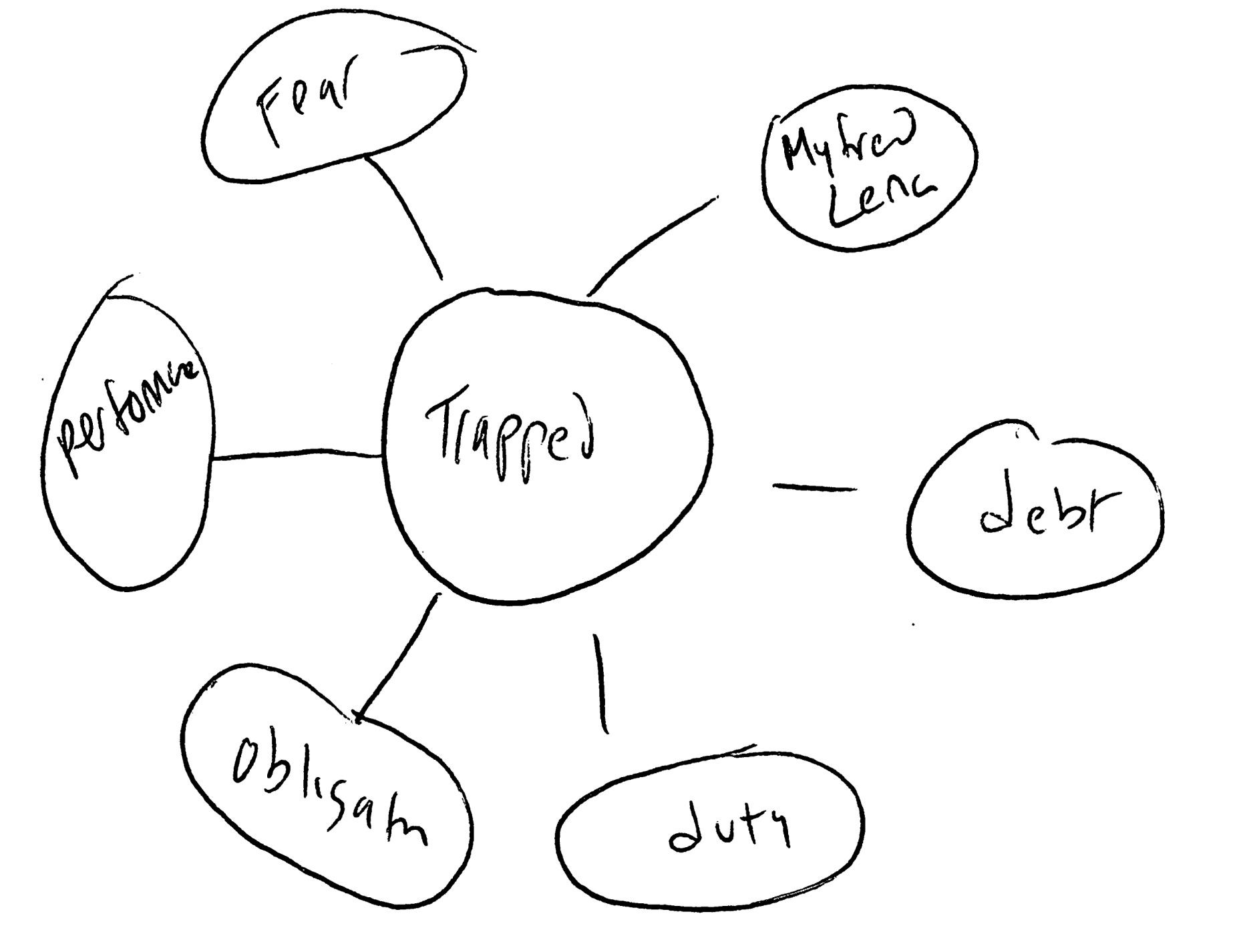
fear
performance
debt
obligation
duty
mother
Lena
Now, using some of those cluster words, here’s a short story:
Story Example
Lena stood in the kitchen staring at her phone while the kettle screamed behind her. Her mother’s name flashed on the screen again, and the whole apartment seemed to get smaller. The room wasn’t actually locked, but it felt locked. The ceiling felt lower. The air felt used up. She knew if she answered, she’d say yes to something she didn’t want to do, then spend the next three days telling herself it was fine. She looked at the deadbolt on the door, the unpaid bill on the counter, the steam fogging the window, and realized the feeling wasn’t really about the phone call. It was the old story again: obligation first, self later, if at all.
Reflection and insight
Now comes the important part.
After writing the story, you ask: What is this story showing me about my situation?
In Lena’s case, the insight might be this:
She isn’t trapped by this one phone call. She feels trapped because the decision is activating an old pattern in which she automatically abandons herself in order to help her mother. The real issue isn’t whether to answer the phone. The real issue is that her priority has always been obligation over self-trust.
That’s insight.
And insight changes the quality of the decision.
Now the decision is no longer, “Should I answer the phone?” It becomes, “Can I stay connected to myself while deciding how I want to respond?”
That is a much better question. Also a much less miserable one.
Part Three: Use Insight to Establish Priorities
Once you’ve reflected on the story, you’re in a much better position to decide what matters most.
This is where priorities become clear.
Many people think they have a decision problem when they really have a priority problem. They want something to be safe, fast, and emotionally painless. That’s adorable, but life rarely cooperates.
Trade-offs are real.
So after the story and reflection, ask:
What matters most right now?
What am I trying to protect?
What conflict is hidden underneath this decision?
What am I no longer willing to betray?
This is also where the heart becomes a center of information.
Not sentimentality. Not mood. Meaning.
The heart often knows the difference between what looks good and what is right for you. It knows the difference between a choice that matches your values and a choice that merely reduces anxiety for ten minutes.
When you reflect on the story, you begin to see which priority is central.
In Lena’s case, her priorities may turn out to be:
self-respect
emotional honesty
peace
a boundary that doesn’t require self-betrayal
Before reflection, she may have said her priority was “keeping the peace.” After reflection, she may realize that what she called peace was actually fear.
That’s why this method works. It helps reveal the hidden hierarchy. Which is useful, because otherwise you’re just calling your panic “discernment” and moving on.
Part Four: Use the Method to Overcome Inertia and Take Action
Once you have insight, you’re far less likely to stay stuck.
A lot of inertia doesn’t come from laziness. It comes from internal conflict. One part of you wants movement. Another part believes movement is dangerous. So you stall, delay, overthink, research, rename the document, make tea, and call it preparation.
The answer isn’t to attack yourself. The answer is to return to connection, identify the real resistance, and then take the smallest true action.
You can use the exact same method here.
Start with the Self-Acknowledgment Hug.
Choose one word for the resistance.
Cluster it.
Write a short story.
Then reflect on the story and ask what it reveals.
If your word is overwhelmed, your story may reveal that you don’t actually have one task. You have five unmade decisions pretending to be one task.
If your word is ashamed, your story may reveal that you aren’t afraid of the action. You’re afraid of being visible.
If your word is stubborn, your story may reveal that your delay is a private rebellion against someone else’s expectations.
That reflection gives you the insight you need to move.
Then you take the smallest true action.
Not the grand plan. Not the perfect answer. The smallest true action. The one that doesn’t require a branding package.
Send the email.
Make the call.
Write the paragraph.
Set the boundary.
Move the money.
Ask the question.
Momentum comes from movement, not intimidation.
Here is the method in order:
1. Regulate
Do the Self-Acknowledgment Hug.
Say:
“I love you.”
“We will always be together.”
“We will always be safe.”
“We are enough.”
“We demand and expect better.”
2. Choose One Word
Pick one word that captures the emotional truth of the situation.
3. Cluster the Word
Let associated words, images, and emotional details radiate out from the center word.
4. Write a Story
Use the cluster to write a short story.
5. Reflect
Ask: What is this story showing me about my situation?
Ask: What does this reveal about what I’m feeling, fearing, wanting, or avoiding?
6. Establish Priorities
Ask what matters most right now and what you are no longer willing to betray.
7. Take the Smallest True Action
Move in the direction of the insight.
Final Thought
Good decisions don’t begin with force. They begin with connection.
When you feel safe, you can receive information more accurately. When you receive information more accurately, you can identify your real priorities. When your priorities are clear, it becomes easier to act.
The Self-Acknowledgment Hug, the one-word cluster, the story, and the reflection all work together.
First you regulate.
Then you reveal.
Then you reflect.
Then you respond.
That’s a much better sequence than panic first and cleanup later.